
Building a Dream Machine: How Computational Thinking Powers Innovation
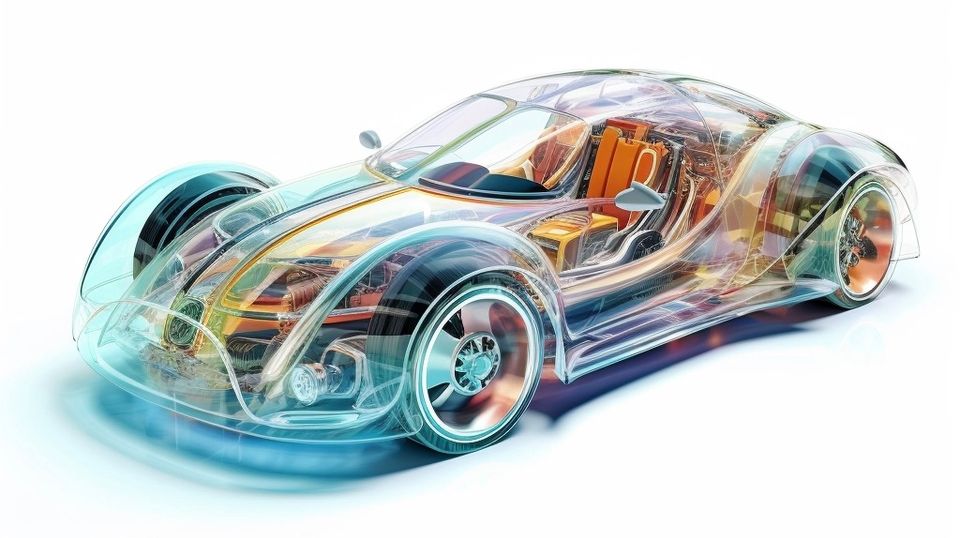
Have you ever wondered how breakthrough technologies are created?
The secret lies in computational thinking — a set of problem-solving skills that powers innovation. To understand computational thinking, imagine you are building a car.
You start with a dream - to build a vehicle that achieves new levels of performance. But you have to start from scratch, without a clean roadmap. So, where do you start?
You start with decomposition 🧩
Decomposition is all about breaking down a complex problem into smaller, more manageable parts like the engine, transmission, chassis, and so on. Think of it as a puzzle — a picture of a beatiful, sleek supercar that you want to create.

This makes the problem space more simplify and easy to work with.
To better illustrate this, let’s look at the engine, a complex part of any car. Instead of tackling the entire all at once, we decompose it into its individual parts: the cylinders, the fuel injection system, the coling system, etc. Each part is a smaller problem to solve, and solving each of these smaller problems helps us undestard and construct the engine as a whole.
For example, if you want to build a self-driving car, you decompose the problem into parts like object detection, path planning, control systems, sensor fusion, etc. Then you can solve each sub-problem separately.
The same principle applies to any complex problem, not just in car manufacturing.
Next comes pattern matching 👣
You analyze existing solutions and find patterns that can be reused and optimized for your design. Identifying similarities or analogies between different problems or domains. You may borrow the basic structure of an combustion engine, but want to boost its efficiency.

If you recognize a pattern, you can apply solutions that worked in the past to a new problem that exhibits the same pattern.
Computational thinking requires abstracting key concepts that can be applied in new ways.
For example, the machine learning algorithms powering facial recognition software rely on pattern matching to detect faces. The algorithms are trained on thousands of examples of human faces, allowing them to spot the pattern of a face in new images.
The other key ingredient in this tech cuisine is algorithms 🧮
Developing a precise sequence of instructions for how to build each component. Creating an algorithm is like writing a recipe, with clear and ordered steps.

Algorithms power everything, from web searches to robotics. Designing efficient algorithms requires logical and computational thinking. For example, Google’s search algorithm, called PageRank, eximines the entire web and ranks web pages by importance and relevance to a search query. It’s like a virtual Sherlock Holmes. 🕵️♂️
The step-by-step instructions must be articulated clearly for a computer to follow.
Algorithms need to be optimized to make the overall design as simple and effective as possible.
Now, we reach a stage in our journey know as abstraction 📡
Abstraction is about simplifying complex systems by focusing on the high-level structure, behaviour, and attributes, rather than the nitty-gritty details.
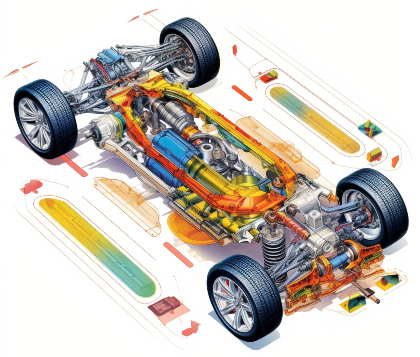
In the context of our car innovation analogy, abstraction is about viewing the car as a system of interrelated parts like the powertrain, the suspension, and the body, without needing to know each and every bolt and wire that holds them together.
The engineers may not need to know the specifics of how the battery cells are constructed, but they need to understand how much power the battery can provide and how it fits into the overall design.
The final step in this journey is evaluation 🧪
Evaluation is the process of analyzing a solution for effectiveness and efficiency, checking if it meets the requirements, and identifying areas of improvements.

In our car design example, evaluation could involve crash testing to ensure safety, checking fuel efficiency, and measing perfomance parameters like speed, braking efficiency, and handling.
It’s not just about “does it work?”, but also “does it work well and meet all our needs?”
Computational thinking is an iterative process, where solutions are continuously refined and optimized over time.
🎨 But you still need creativity. Coming up with an innovative new design requires imagination and experimentation. You try new configurations, make modifications, and improve the algorithms.
Computational thinking balances human inspiration with computer-like logic and precision.
With computational thinking, you can build not just a car but any complex system. From artificial intelligence to renewable energy to new medical treatments, computational thinking is the engine that drivers human progress. By breaking down big problems, reusing effective patterns, developing optimized algorithms, and continuously improving designs, computational thinking makes the impossible possible. With practice, anyone can become a master builder.
📌 Practical advice and questions
Here are some examples of questions and tips for practicing and improving computational thinking skills. For example:
- How can you break down a large, complex problem into smaller parts? What are the components of the system?
- What analogous problems can you compare this too? What solutions or approaches have worked for similar problems?
- What is the optimal sequence of steps for solving this problem? How can you improve the efficiency and simplicity of this algorithm?
- What are the essential concepts, properties and relationships in this problem? What details can you ignore or set aside?
- How well does your solution achieve the goals and objectives? What key metrics can you use to evaluate performance?
🏃♂️Practive every day! Solve some small exercises or puzzles or review examples of how others have used computational thinking to solve difficult challenges.
🎖️ Challenge
And for a fun, practical challenge: consider planning a vacation. Use computational thinking to break down the task into smaller components (travel, accommodation, activites, budget), identify patterns or similar situations(previous trips, advice from friends), abstract away unnecessary details (you don’t need to know the mechanics of the airplane, just the flight times), develop a clear algorithm or plan, and finally evaluate your plan (did you stay withinn budget, did you enjoy the activies you planned?).
See how applying computational thinking can make a complex task manageable and even fun!
🔔 Stay in the loop! Subscribe here and never miss a story. 🌟 We’re just scratching the surface of our learning adventure! 🌍

Member discussion